Artist Profile; The Italian Lion Vincenzo

“New York is a Jungle and I want to know what kind of animal I am – and I’m a fucking Lion”

Vincenzo

Recently, whilst staying at the Treasure Hill Artist Village in Taipei, I met the combative but brilliant Street-Artist, painter and storyteller Vincenzo.

Vincenzo originally hails all the way from Napoli in Italy, but has been living an itinerant existence around the Pacific Islands and South-East Asia for some time.

More recently, he has spent time in Kuala Lumpar, Bangkok, Vietnam, Taipei and more extensive periods in Malaysia.

His mannerisms are rough; he seems to be built of the mould of rough Italian clay and he has the bombast and air of a boxer. Deep down he is a lover however, as was revealed slowly from our chats.

God drives you to create. You create good energy. You make the people happy. The meaning of painting on the street, it makes people happy; the meaning of life is to spread happiness.

Vincenzo
Vincenzo uses Mixed Media to make his Art. He uses fabric, paints on historic maps of Taiwan and has a series of iconic characters such as General Custer and the Lakota War Leader Crazy Horse

Vincenzo is as much a product of Brooklyn, as he is of Napoli. He constantly told me, “I speak Brooklyn brother, not English.”

In fact, he first learnt Spanish through working with Latinos in the restaurant industry in New York, and then picked up a street-dialect of English; heavy on expletives and saturated in a thick Brooklyn accent.

He is the living embodiment of an on-the-streets style education; his English and Spanish essentially being ‘picked up’ rather than learnt through any formal classes, in various restaurants he worked at.

He now creates and shapes his art on the streets of Taiwan.

(By the time Article was published, Vincenzo had returned to his favourite spot on Peel Street in Hong Kong)

The streets are a symbolic union of creativity and a battleground for survival for Vincenzo.

God is around me, and he says this guy is a bad guy, but not too bad.

Vincenzo, donning his best Rocky Balboa persona

When I met Vincenzo, I instantly bonded with him. His down-to-earth, Italian mannerisms and language were a refreshing, and almost shocking, change from usual dialogues in Taiwan. It brought back pleasant memories of my time in Milan.

A novel idea popped into my head; I decided to try using the Marcel Proust questionnaire to guide our conversation. This gave me the benefit of having a structured conversation with a man where, at any moment, the conversation could be derailed. The Questionnaire itself is essentially akin to a 19th-century personality test; a list of questions designed to get a richer understanding of your subject.

We talked about the meaning of art, how to survive by creating on the streets, and we touched on Vincenzo’s fascinating, but meandering life – from the depths of Napoli and Southern Italy all the way to New York, at the age of 28.

So with that said let’s jump into the questions;

What is your idea of perfect happiness?

“Making my art is not automatically, but it is fluent – I only need the space. Making Art is a present from God.”

Is Art Divine?

“It’s like God drives you to create. When you make art you create good energy. At the same time you make people happy. The real meaning of painting on the streets is to make people happy. They pass for a second and they see all this shit on the street – but the art makes them happy – that is my goal.

I think what is Art? Art is to create a good mood, a good vibration.

The only condition to be happy is to make others Happy. My art is a way to make people happy.”

Vincenzo’s set up on the streets – whether in Malaysia, Rome or Tainan, you can witness his persona and craft all in one package

What is your most marked characteristic?

(For this question I had to use Google Translate to put it into Italian)

“I don’t speak English brother, I speak Brooklyn! I don’t know what this means, I learnt to speak english in Brooklyn, in a kitchen, brother! I never study anything. I learnt Spanish first in New York, and then English! Because I work in the fucking kitchen brother!

(After reading in Italian) My characteristic is to be on my own, and with God. I only trust God. I saw enough motherfuckers, but someone I trust, I trust God.

Why did you start working so young? You started working at 14 in a Kitchen in Napoli.

“Oh when I was 14, I was already old man! I knew kids that worked in the kitchen they were 9 or 10! Fuck man, I was a big guy at 14. Crazy man! Napoli is crazy. In my generation 14 you’re already fucking old to work.

I went to New York because it was a dream. I have a fucking good job in Italy – new car, brand new scooter. But I wanted to see what animal I am. I think New York is like to live in a movie, and I want to see. New York is a fucking jungle man, and I want to know what animal I am. And I realise I’m a fucking lion man!”

Vincenzo posing on the streets of Hong Kong

How did you go to New York?

I had a Ford Gear, I had a Vespa. I have a nice car. I had good money in Italy – so I go!

I was involved in a beautiful love story.

No, I was never Married to be honest. Oh hello, first of fall, I work in this place – this man was an Architect, and I knew his restaurant was open only for dinner. So I have a very nice job, because I go to work 3 o’clock in the afternoon.. Open only 5 days a week.

Very rich, nice customers. I make 1400 euros every month, 35 years a go! And I only pay 200 euros a month!

I have a very comfortable life man.

So why did you decide to give up this fairytale life for New York City?

I was not very happy, but I have everything I need.

I only want to tell you when I go to New York I have 20 million Lire, its like 10,000 euro.

I didn’t go there broke. I had money man.

Apart from the money, why else did you think “Yeah I love it here in Rome, but I want something different?

I remember the boss of the restaurant said to me, “For some things I understand you, for some things I cannot understand you”. He said you have a nice job, everybody like you, even the customer like you. Because it was like a family. Only 35 people for this restaurant.

But I want to see the world. I want to be in New York. I don’t know if I want to travel, but I want to be in New York.

Did you have friends in New York?

No, I got no-one. I decided go on my own. I live there for a decade, from 1990 to 2000. Then I spent a year in California. And California is fucking boring man. You were born in 1990, I moved to New York (in 1990).

February 2001, I decide bus to Miami. I stay there awhile, and then I go L.A.

In fact, when they attacked the Twin Towers, I was in California. I was not in New York anymore.

Did you meet Andy Warhol in New York?

I wasn’t involved in art. I was a chef. I was there at the opening of Guggenheim Museum. I was there! I meet the architect – I cooked for them. It was a beautiful month.

What do you consider your greatest achievement?

To be a Father.

You know, if you make a mistake you need to pay. I always say this. It means, if you do some shit in the life, you need to pay. Not if you make some shit, you run. You need to face it and solve it. That’s the biggest achievement in my life.

What learning curves are you referring to?

For example, my daughter was the most beautiful accident in my life. I never planned to be a father, it was an accident. I need to fix this. The most beautiful accident.

My wife is from Vietnam. She is a refugee. You call them ‘Boat People’. (In the late 1970s, hundreds of thousands of refugees fled to Hong Kong by boat from war-torn Southeast Asia and Vietnam)

Who are these ‘boat people‘?

These people escaped from Vietnam by Boat. My wife came to Hong Kong.

In the 1970s many Vietnamese made the arduous journey across the South China Sea. Many would die on this voyage. These ‘Boat People’, as Vincenzo referred to, were seeking sanctuary in British ruled Hong Kong.

How did you meet and fall in love with a Refugee from Vietnam?

Well I’m a Napolitano. It’s not hard for me to catch the women. Hong Kong was safe for her. At the time, Hong Kong was British, and they helped them.

Do you have a deep love for Hong Kong?

I’ll be honest – I don’t love Hong Kong. But I love my daughter. I never fell in love with New York, but I love my daughter.

She’s 20, she’s smart, she’s strong, she’s intelligent. And now I feel I can enjoy my life as an artist. It’s not difficult to understand my way.

I’m a street fighter. I smash anyone who says I don’t care for my daughter.

It sounds like to me, you had to learn to fight at a young age. Either in Brooklyn or in Napoli. Would you agree with this?

I’m a respectful person. But if people make trouble. It’s automatic for me. It’s a disease man. There’s no medicine. I cannot stop. I can’t just go to the Doctor. I can’t fucking stop.

Especially in New York. One guy from the first floor. I said, ‘if you don’t shoot, I come up and broke you.’

I feel people just shoot, they don’t talk, they just shoot. So I think maybe no, he didn’t have a gun.

Vincenzo stayed at the Fuqi Hostel in Tainan. The owner took pity when he saw he was struggling to sell his artwork on the street. He organised for Vincenzo to paint on the walls of the Hostel with the help of a girl working there.

What is your greatest fear?

If I cannot make Art anymore. I think this is my biggest fear, if I cannot produce art anymore.

Maybe if you asked me 20 years ago, I give you a different answer. But if I can’t create, then what do I live for?

Which historical figure do you most identify with?

I like the film The Deerhunter. I grew up with my Grandparents. I never had a childhood or many friends. But I like this character from The Deerhunter.

Are you the first to make art in your family?

I am the only one.

My Grandfather was funny. He fought in both World Wars.

In the Second World War, he brought his son with him. He was only 17. And he died, he never made it back home. This was my Uncle. I never met him. He was my Father’s brother.

My Grandad survived the War. Then my Grandmother stopped talking to my Grandfather. (She blamed her son’s death on her husband)

On Bulu the Cat, you can witness Vincenzo’s use of fabric

Who are your living heroes?

I only have one hero – and that is God.

I’m a difficult man to be with. When I decide to go – then I go.

Thank you for your time Vincenzo

Talks with Students

Groningen on one of those starry-eyed Sundays

Recently, one of the fellow students on my course decided to leave Groningen in the Netherlands to return home. This was by no means a strange occurrence, the main difference here however, was my friend was returning to Bergamo, the epicentre of the pandemic in Italy.

With the world standing on a strange precipice right now, many students have been frantically returning home, or desperately trying too.

One of my friends abroad recently graduated, having to enjoy the celebrations virtually. Here’s to spilling the champagne all over your laptop, as you strain a virtual smile to the Dean of your faculty. Japan even have iPad’s doing the job for us. The world of automation has finally come to good fruition. All we ever needed was a pandemic.


My aforementioned friend wrote a very moving Instagram post about leaving Groningen, so I set out to understand his point of view. I wanted to hear what had lead to this decision; were his fears grounded in reality; the different responses from the two respective countries; and finally if he would be able to keep studying at such a time.

In advance, thank you Andrea.

Andrea, Student at The University of Groningen

Hello Andrea. 

I know you’ve recently decided to leave Groningen and return to Italy. 

I hope to ask you some questions and in turn have a conversation which others around the world will hopefully find enlightening at this troubling time. You are an International Student studying International Relations at Groningen, and I thank you for your insights.

So with that, let’s begin;

With the current global situation still escalating in some countries, whilst slowing in others, it made me think that perhaps the course currently feels irrelevant.

Can you tell me, under the current circumstances – and taking into consideration the fact that the course has a focus on Globalisation – do you feel the course is irrelevant? Or is it the opposite, is it more relevant than ever?

A: I don’t think the course of study is irrelevant. On the contrary, I believe that this global pandemic demonstrates that on certain issues, in this case health security, it is essential for the future to have well-structured prevention plans at the global level. Certainly for those like us who are still  students, and that now find themselves in the position of approaching the world of work in this period, this international context of crisis does not help. As you know we have a mandatory internship in the course, and probably given the circumstances it will be very complex to find one. 

Nevertheless these are two different discourses: now it is certainly more difficult to find a window to enter into the field of work. Nevertheless I don’t think that the sector has become irrelevant. There are still much things that need to be done, probably even more than before.

Groningen by day

You mention in your post that you see the University as a representation of your commitment to reach your goals. Considering what has happened, do you feel your goals have been put on hold somewhat, or do you still feel invigorated and motivated to work?

A: Certainly the University of Groningen, at least for me, has a deeper meaning rather than representing just a simple academic path: I see it as the representation of the way that I want to follow to achieving my future goals.

The current situation does not change my goals. And it doesn’t change my motivation either.

But it can certainly make these goals more difficult to achieve. For example, as mentioned above, in our course we have a mandatory placement; that part of the course has always been the one that intrigued me most.

I could not wait, and still can’t wait, to get involved in an international working context linked to my field of study. 

This pandemic obviously slowed down the application procedures, possibly even making them disappear completely. 

Surely this will have an impact on several students of our course who will have much more difficulty in finding an internship.

Like everyone else I will have to try to do my best to overcome these new and unexpected difficulties that the world has put in front of our face.

Andreapost

To recap, you recently left Groningen to fly back to Italy. Could you explain your decision, or the main focus of your decision?

A: My decision arose mainly from the desire to spend this period at my home in Bergamo, with my family.  Primarily because I believe that being close to your beloved ones is important in such a complicated period.

Moreover, given the online nature that courses will have for the whole semester, I decided to return to Italy also to save money on the rental price – which I obviously don’t pay anymore – since my presence in Groningen become quite superfluous.


Was there any resistance to your decision to head back to Bergamo, knowing that it was particularly hard-hit by the pandemic?

A: No, on the contrary my family was pushing a lot for my return. 

Furthermore you have to consider that I came back when, although  the situation was still serious, the worst crisis in Bergamo was already passed.

Having now returned to Bergamo itself to see your family, can you comment on the atmosphere upon returning? Has it been a difficult transition?

A: Personally now that I am at home with my family I am experiencing a good atmosphere. We are all happy to be together and we are enjoying the beautiful sunny days being out in our big garden, trying to make the most of this period of “forced rest” at home.

But I have to say that surely arriving in Italy you can breathe a much more serious and heavy atmosphere regarding the pandemic. 

In Groningen, on the whole, the situation has always remained quiet and almost normal. In Italy on the contrary no, especially in Bergamo the people have suffered a lot – with death rates 10 times higher than normal. 

The impact I had with the scrupulous controls in the airport, with deserted highways and with a life that seems to have stopped completely, with people locked in houses, is certainly strong and makes you think a lot.

However now the situation is slowly improving, people are pushing for the possibility of going out more and more. 

There is a bit of a division in the society between those who would like to reopen as much as possible and those who still have in their heads the images of the coffins leaving Bergamo on military vehicles, and therefore are more cautious and call for attention. 

We are in a period of transition, as most of the world, with which we still have to deal.

How has it been experiencing two different sides of the lockdown, from Groningen and now Italy?

A: In Groningen I could go out without problems, meet with 3 friends and spend a nice afternoon in the park. The only real measure was keeping the 1.5 m distance.

Of course the bars and restaurant were all closed, but still the life was quite enjoyable.

To make you understand, in Groningen if you went around with a mask you felt observed, judged almost as you were doing something exaggerated. 

In Bergamo the masks are mandatory.

These are two uncomparable situations.

The response to the Pandemic has differed from country to country. Some responses have been praised, others have been criticised. Knowing what you know about the Italian government, can you tell me your feelings on their response? Is there any resentment from the local people?

A: I can certainly say, that especially in Lombardy there have been serious shortcomings by local politicians who initially underestimated the seriousness of the problem. The Bergamo area should have been closed much earlier, and separated from the rest of the region. This was not done for economic interests, since Bergamo is one of the most productive and economically rich provinces of the whole nation. 

This “not-done” closure has certainly had terrible repercussions on the population.  Lombardy alone has nearly 10% of Covid’s worldwide deaths – someone has to take responsibility for these deaths. 

There is therefore surely a big resentment in the local population.

Then the government did what was necessary to deal with the horrendous situation that came into being, so they blocked the entire country.

On the long term this will have huge economic implications, and the national public debate is now touching on this point a lot.

Ameland in the Netherlands, north of Groningen

Thank you for your time Andrea. 

One final thing would be to ask what your plans are going forward and what you envision for yourself after a semblance of normality returns to the world?

A: I personally aim to finish the Master lessons as soon as possible, so then I can focus solely on the internship.

Of course I would like to start to work later, but I will see what will be possible.

Thanks to you Tom.

So there we go. Thanks again Andrea.

This begins a new series I will be dedicating to talking to students.

At a time like this, it’s imperative to hear these personal accounts of hardship, so once the dust settles, we realise that we came together to triumph over adversity. Where the human spirits lies, the human spirit will prevail.

Dreams of Italy

It is necessary that the daily becomes heroic and the heroic becomes daily.
John Paul II

By the dim lights of Delhi, I saw hundreds that night, under trees, shrines, intersections, on benches, squinting at newspapers, holy books, journals, Communist Party pamphlets. What were they reading about? What were they talking about?
But what else?
Of the end of the world.
Aravind Adiga, The White Tiger

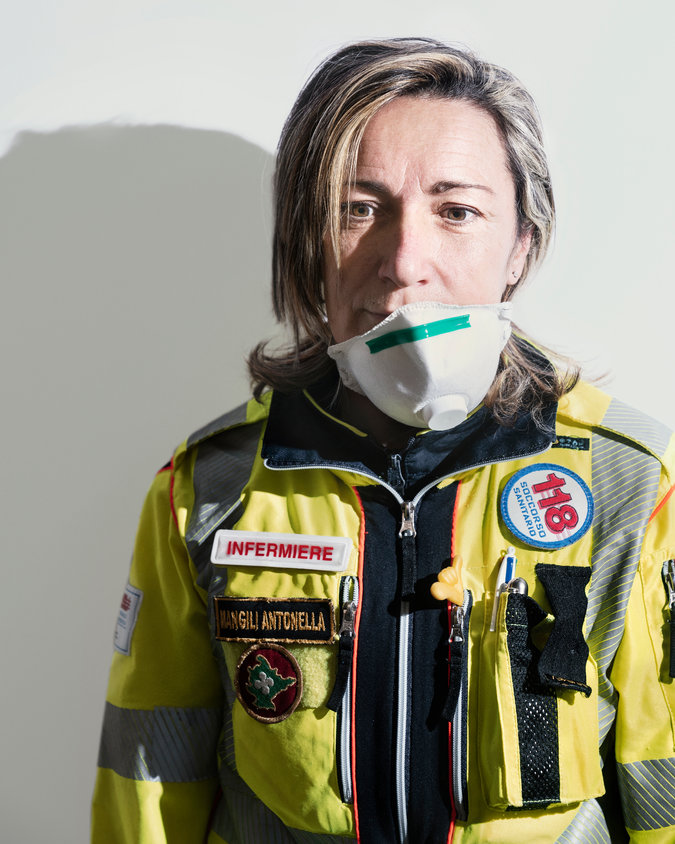
Reading this article in the New York Times Magazine, for some reason, set off a chain of events in my head. Both moving and personal, this account of a photographers desperate attempt to portray the unravelling crisis in Northern Italy, all the while underpinned by his own family’s precarious circumstances, is a very moving read.

It is a very moving account of how the pandemic first seized power on the people of Northern Italy, and of the heroic actions of the medical staff who desperately tried to put out fires, whilst also trying to maintain their own sanity.

It struck me that this photographer, Andrea Frazzetti, realised quite instinctively what was unfolding. This was in contrast to some of his family, which, like the much criticised government, were slow to react. Unfortunately, as has been seen, this lethargic response proved to be deadly.

Of course now the present is far from perfect, but in the midst of all that has been happening in Northern Italy, some light at the end of tunnel gingerly seems to be filtering through. Of course, I do not want to speak too soon. I have not dwelled on my time in Italy, but it does strike me how in many ways, I left just before the explosion. Just before things got really bad. I was even in Bergamo in early December. All these places have recently become stamped on our collective consciousness.

My time in Milan was chiefly characterised by instability. Dragging my belongings from hostel to hostel down busy roads in the Porto Romano, finding a few chic cafes and a little home-made vegetarian place VegAmore – which I’m sure has been hard hit, but I do hope has not been closed down – my life ambled on chaotically. You could almost make a film of it; set to the Benny Hill music.

I was very fortunate to meet some great people at the Queen’s hostel. There was a group of South American, mainly Brazilian, guys who worked there. Mostly volunteers, they showed me some of the magic and delights of Milan. It was still a shock, to have come from a small city such as Groningen to a bustling metropolis like Milan, and suddenly having money to spare too.

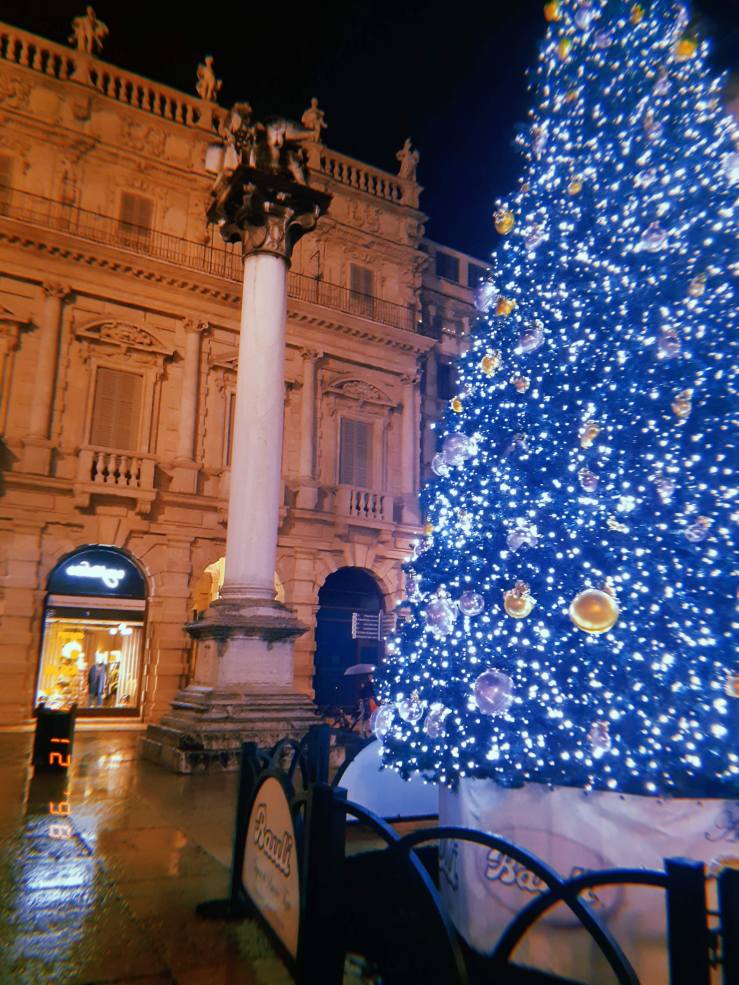
Training in Verona

Undoubtedly things went from bad to very bad, quite quickly. It became apparent that finding somewhere to live would not be an overnight endeavour. I had this strange double-life, with people I met at the Hostel and then business-as-usual at the school. I remember going to a flat viewing with an Italian actor, who had spent time in the hip Brent Cross in London, and seemed to spend much of his day meditating and doing a form of Yoga I had never before witnessed.

One morning, I tried talking to him, and he told me not to disturb him, “the problem is, I need to spend the whole day in the Vortex, Tom.”

However, this was a man who went by the moniker ‘Baby Rush’.

Baby Rush himself…

Now of course, looking back, it feels like I was incredibly fortunate. Not that I didn’t bring some of the hardships on my self. But the constant chaos with its brief respites, which mainly consisted of hanging out in the cold sunshine of Park Sempione with a Brazilian girl I had met at the hostel, seems now to be a trite comparison to the current state of affairs.

My problems were never really problems in the grand scheme of things. Mine was only one story, meandering its way through the rubble and street-life, just as many were doing. To look back and appreciate in its chaos, a learning curve, is to unequivocally accept what I could not accept at the time. The option to see the trees and the wood.

The people I knew from my short time there, are all fine. So that is great. Of course, their lives have been greatly affected; the school I worked at is of course closed down. The hostels too, no doubt, will not be offering accommodation to either the needy or the less needy.

Christmas Decorations in Milan

I remember one evening after work, nearing the end of my time in Italy, feeling a little lost and depressed, I took a walk to the centre of the city. I hadn’t wanted to go back to the hostel, nor see the Duomo and its surroundings, so I went walking.

It was a week-day and this was a shopping precinct, so it was quiet. Just the dazzle of the nearby glass interiors of the shops, Christmas glowing from inside, like the belly of a colourful beast. The lights spilled out onto the streets. The occasional Tram went by, and a few cars cruised down the central road. I remember seeing tinfoil and feeling dazed from the lights.

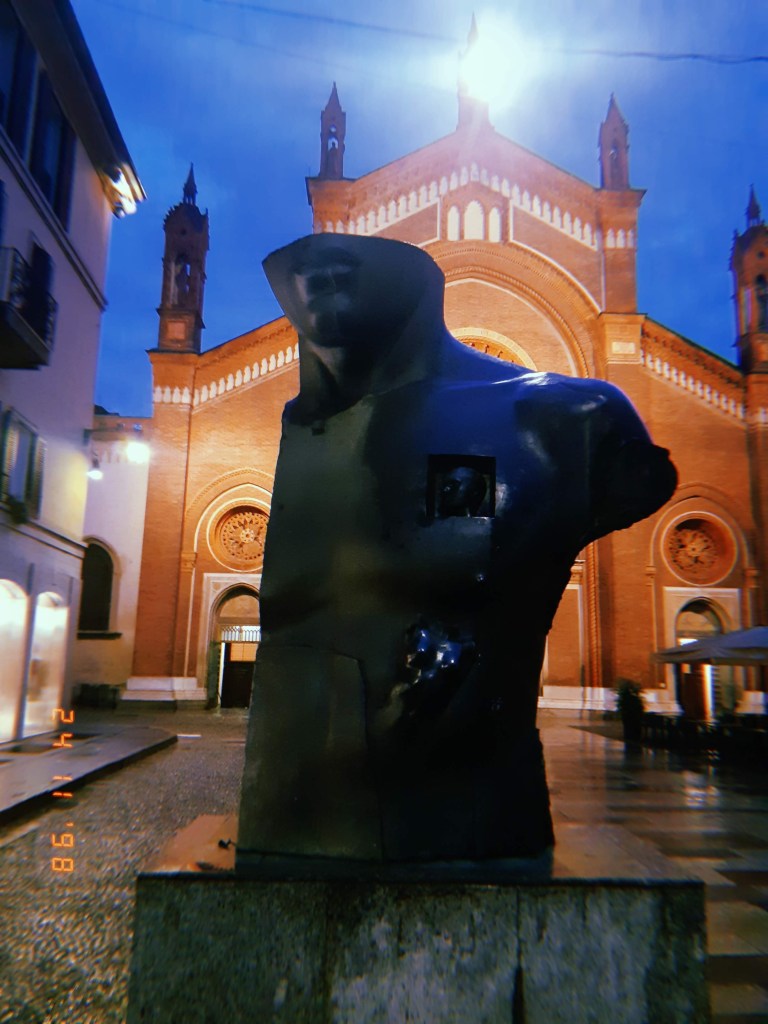
The Santa Del Carmine

I saw a homeless man. He had nothing but his dog and a tent. No-one bothered him, and he was busy – moving his things and preparing for the night. I approached him with a smile. At first he was taken aback, and scoped me out. Seeing I did not pose a threat, he relaxed and looked at his dog, who was sleeping. I handed him a beer, and tried to speak in broken Italian. He responded in broken English. We had an awkward conversation, then enjoyed a drink and looked heavenwards. The stars were out that night. Hopefully they are still out for that man. Hopefully, somewhere now, he is in a good place. Perhaps a better place. I’m lucky enough to say I am. Cliched as it is, right now, only time will tell.